|
News & Events |
| |
|
Lots of stuff is going on.
|
 |
|
More... |
Featured Solution |
| |
 |
|
The research on tDCS
Read More
|
|
|
|
| |
|
|
| |
HOW tDCS WORKS
|
| |
|
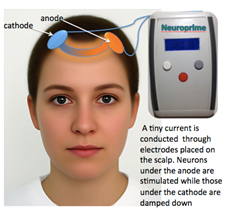
FTranscranial Direct Current
Stimulation (tDCS) is one of several neuromodulation
techniques which work by sending small electrical
currents through the brain to alter the activity
of neurons. The current is minute - less than
2milliAmps. It is barely enough to make an LED
glow and many thousands of time smaller than the
minimum required to do any damage to tissue.
Gentle though it is, tDCS
has been shown to have clearly measurable effects
on the way the brain works. Inhibiting the neuronal
circuits associated with cravings, for example,
can help people with addictions to resist temptation.
Conversely, stimulating a person's pleasure/reward
neurons makes them more likely to register good
news. They become a little readier to respond
to a smiling face or more appreciative of a beautiful
view.16
Each treatment lasts for
twenty minutes, and most people find it quite
relaxing. You may feel a tingling or mild burning
sensation under the electrodes for the first part
of the session, but many people feel nothing at
all. There is no actual rise in temperature, and
when tDCS is used properly there is little or
no risk of adverse effects. (see research). Standard
treatment is five daily sessions of twenty minutes
each though some peoplemay require more to get
maximum benefit. Unlike other brain stimulation
techniques (eg TMS transcranial Magnetic Stimulation)
tDCS does not work primarily by altering brain
activity during the treatment. Its effects are
achieved by altering the neurons in a very subtle
way so that they are more (or less) likely to
become active when they are next confronted by
an appropriate stimulus. Nothing dramatic is likely
to be felt during the treatment, therefore - the
benefit comes later. The effect of tDCS should
be lasting, or even permanent because it kickstarts
a natural process in the brain by which the alteration
in activity encouraged by stimulation are consolidated
naturally. (See the science bit, below).
|
| The
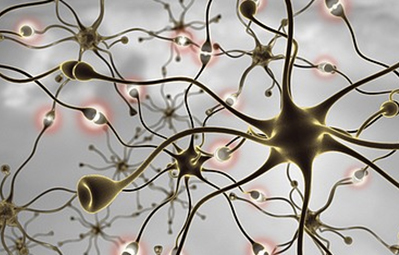
Science Bit: Neurons - or nerve cells - make up
about one tenth of your brain, and they are responsible
for generating all your conscious and unconscious
emotions, thoughts and actions . They are different
from other body cells in that they create little
electrical explosions which send pulses of current
to their neighbours. The electric potential of nerve
cells springs simply from a very basic physical
fact: given a chance , electric charges will even
up. If you have a cell containing a chemical mix,
and there is a different chemical mix outside the
boundary, there will be a difference in electrical
charge between them because different chemical mixes
create different electrical states. The difference
in charge between outside and inside is the cell's
electrical potential. Every cell in the body has
a tiny electrical potential, but neurons have much
more. If the difference in charge between the inside
of the cell and outside reaches a certain critical
level, microscopic channels in the nerve cell's
membrane open up and allow a free flow of charged
particles to pass through them until the charge
on each side is evened up. The resultant spike of
electrical activity can pass from one neuron to
another like a spark along a trail of dynamite.
This is what is meant by neural "signalling", or
"communication". |
|
|
|
The charge is carried along the cells axon -
a thin, snaking tentacle - to another neuron.
|
|
Most nerve cells fire because they are stimulated
by their neighbours but certain sensory neurons
- those in the retina or the skin for example
- can be triggered by the effect of external stimuli
such as light or heat. These cells pass on the
message through pathways (often referred to as
"wires" ) formed by the axons.
The pathways form an immensely complex network,
which is constantly changing in response to experiences.
The network develops to a genetically-determined
blueprint which is similar in every normal brain.
However, the precise pattern is different for
everyone, just like the lines on one's palm. Indeed,
it is the differences in brain anatomy that make
us individuals.
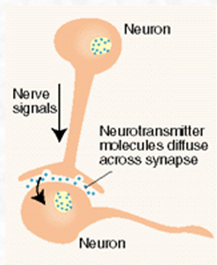
Axons do not quite touch the cells they are signaling
to, and the minute gap between them is bridged
by chemicals called neurotransmitters. These are
released from the tip of the axon, from which
they drift over the gap to the receiving part
of the second cell - the dendrite. If enough of
the rght kind of neurotransmitter makes contact
with the second cell, that will fire too - and
so on.
|
|
|
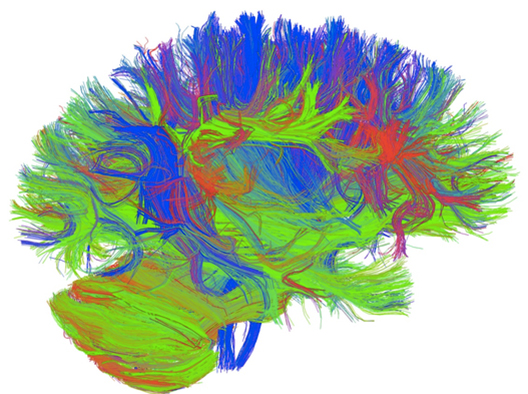
| The
pathways that carry electrical activity around the
brain are slightly different in each of us |
|
|
|
There are hundreds of neurotransmitters - better-known
ones include serotonin, dopamine and noradrenalin.
Drugs for conditions such as depression generally
work by altering the levels of one or more of
these neurotransmitters, making signalling between
cells more or less easy. Like tDCS, the idea of
them is to change the brain's pattern of electrical
activity , but unlike tDCS it is a very indirect
way to do it. The drug has to get into the bloodstream,
through the liver, into the brain and then find
the right neurons to work on. Not surprisingly,
such drugs have uncertain and sometimes unpleasant
effects. tDCS , by contrast, works directly on
the relevant neurons and does not therefore affect
any other body systems. One crucial aspect of
tDCS is that it is targeted correctly. Different
parts of the brain, and different circuits within
do quite different things. The anode and cathode
must therefore be carefully positioned, depending
on the aspect of brain function being addressed.
For mood enhancement and memory, for instance,
the electrodes are usually placed over an area
of the forebrain. Pain requires that the electrodes
are placed farther back on the cortex, and tinnitus
has been relieved with another arrangement.
Although the current from tDCS reaches only surface
neurons, the effect "knocks on" to deeper regions
of the brain due to the long-distance signaling
described above. Hence a local stimulation can
encourage widespread activation involving many
different groups of neurons. This sort of linked
activity creates "whole" experiences , such as
a pleasurable response to a smiling face. And
the more intense the activity, the more likely
it is to be conscious and clear rather than some
vague, quickly forgotten impression.
When neurons fire together they start to bond,
and the more that a particular group of neurons
fire together - the "smiling face" group, say
-the more likely they are to fire together in
the future. Repeated synchronous firing causes
the neurons involved to form physical connections
- the "wires" that carry electrical information
around the brain. As the T-shirt slogan puts it:
"neurons that fire together wire together". Once
a group of neurons have physically "wired" together
they are even more likely to fire in unison. They
have become a "habit" of mind. This is the basis
of all learning, commonly referred to as neural
plasticity. Hence tDCS triggers a natural process
which leads to long-term change.17 To take the
example above, by kick-starting the neuronal response
to smiling faces it encourages the brain to rewire
itself in such a way that it is quicker to register
positive emotional signals. This in turn crates
- literally - a new "you'.
|
| |
|
|
| |
|
|
|